
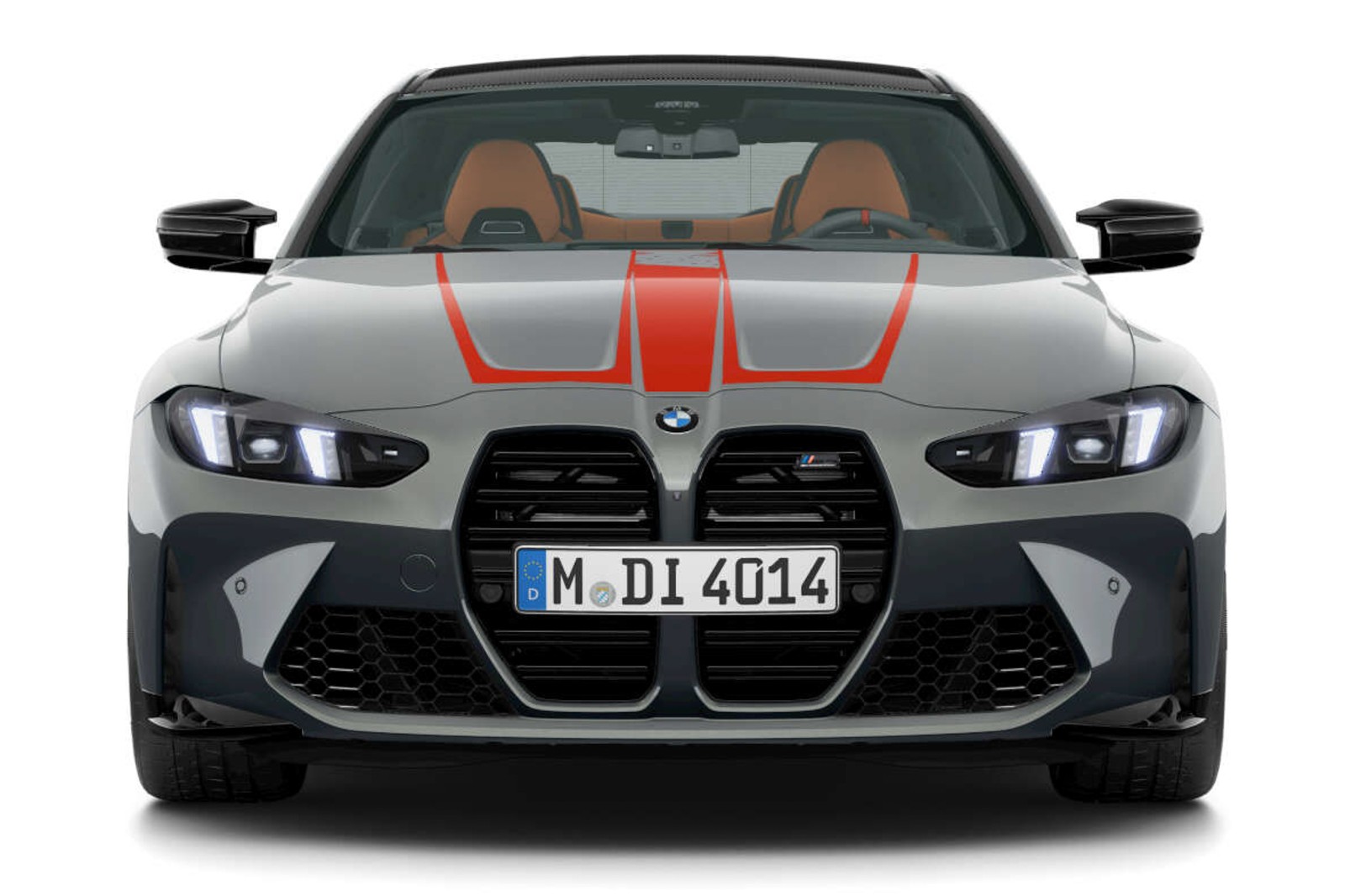
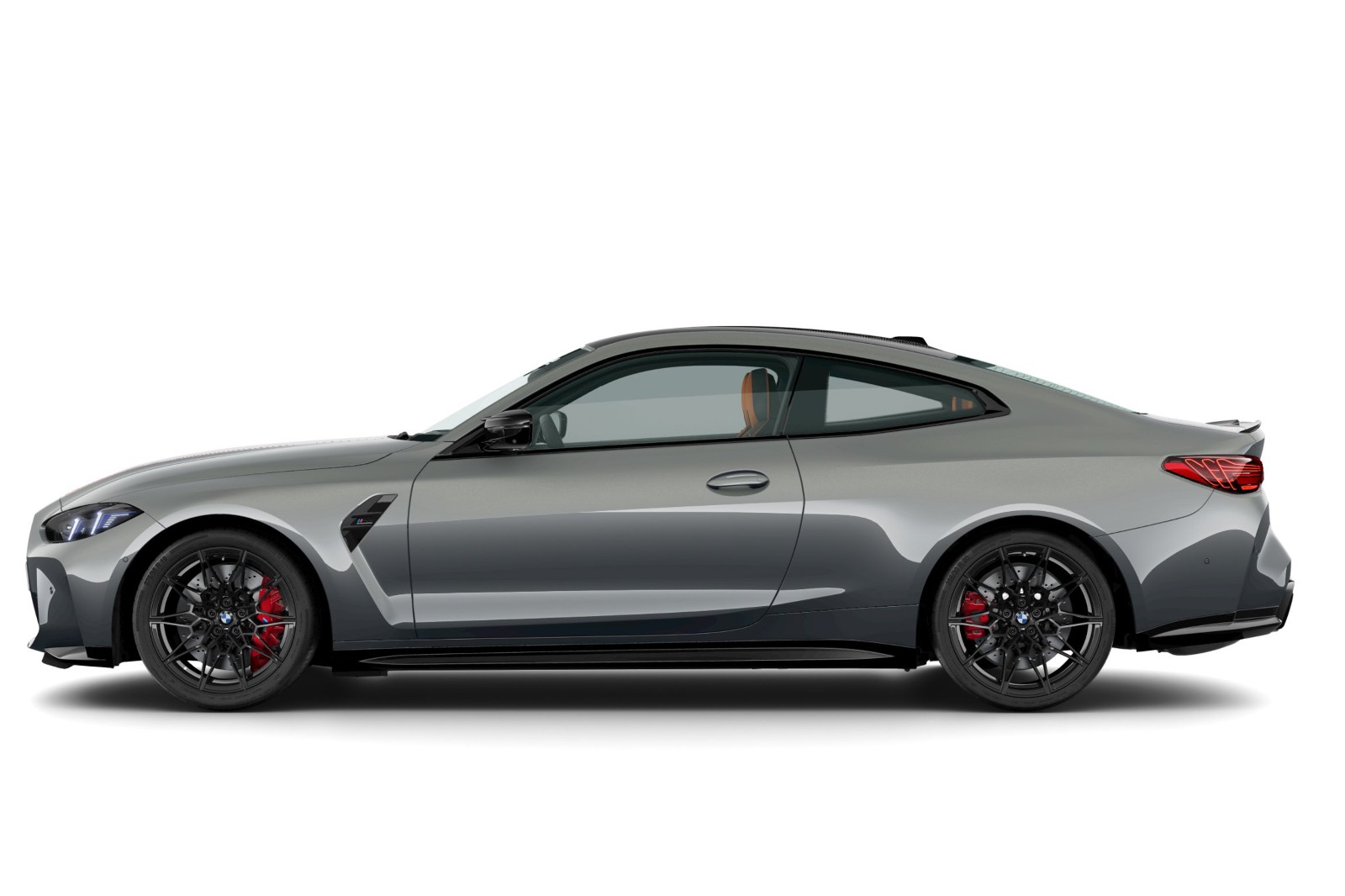
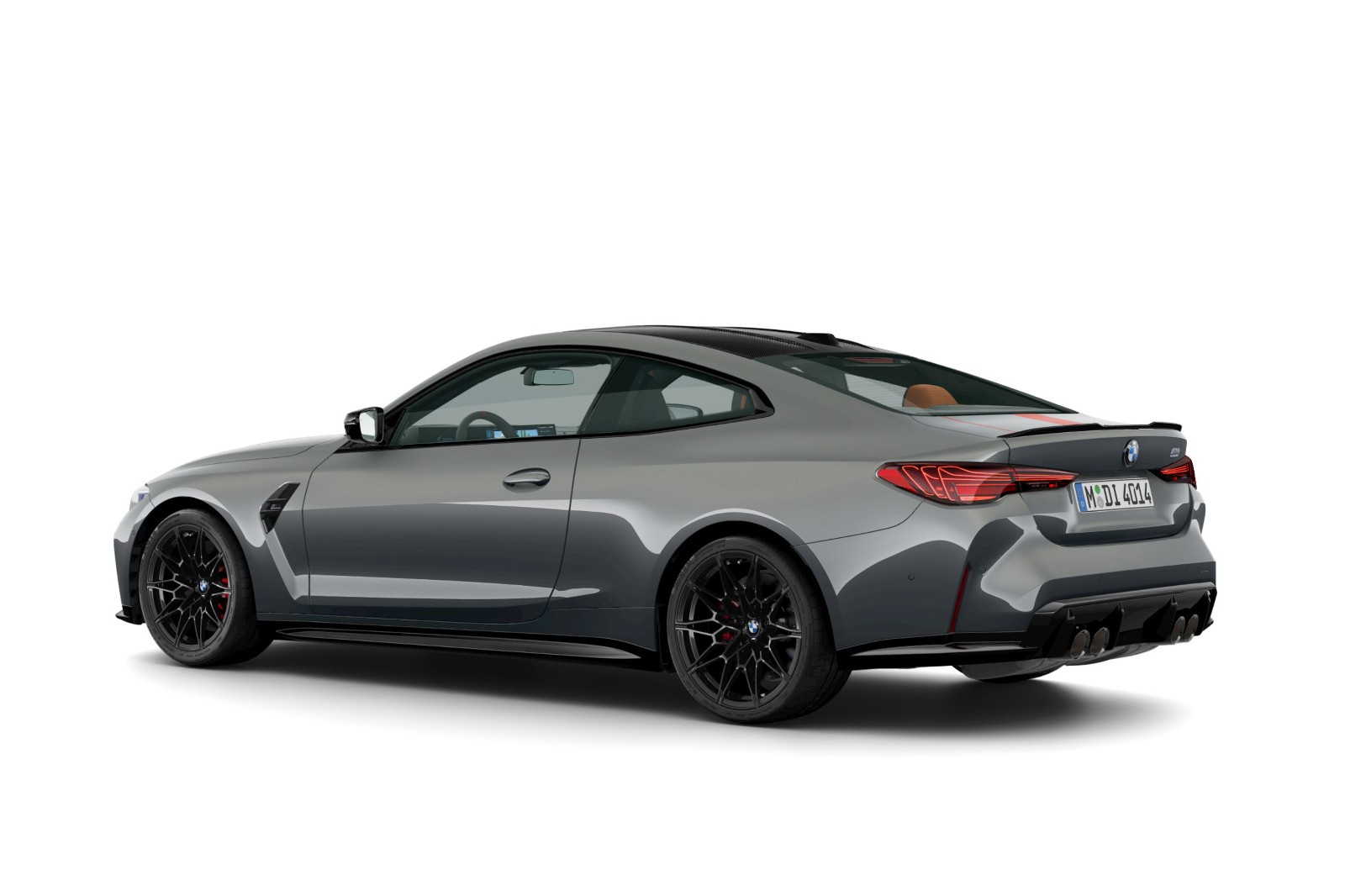
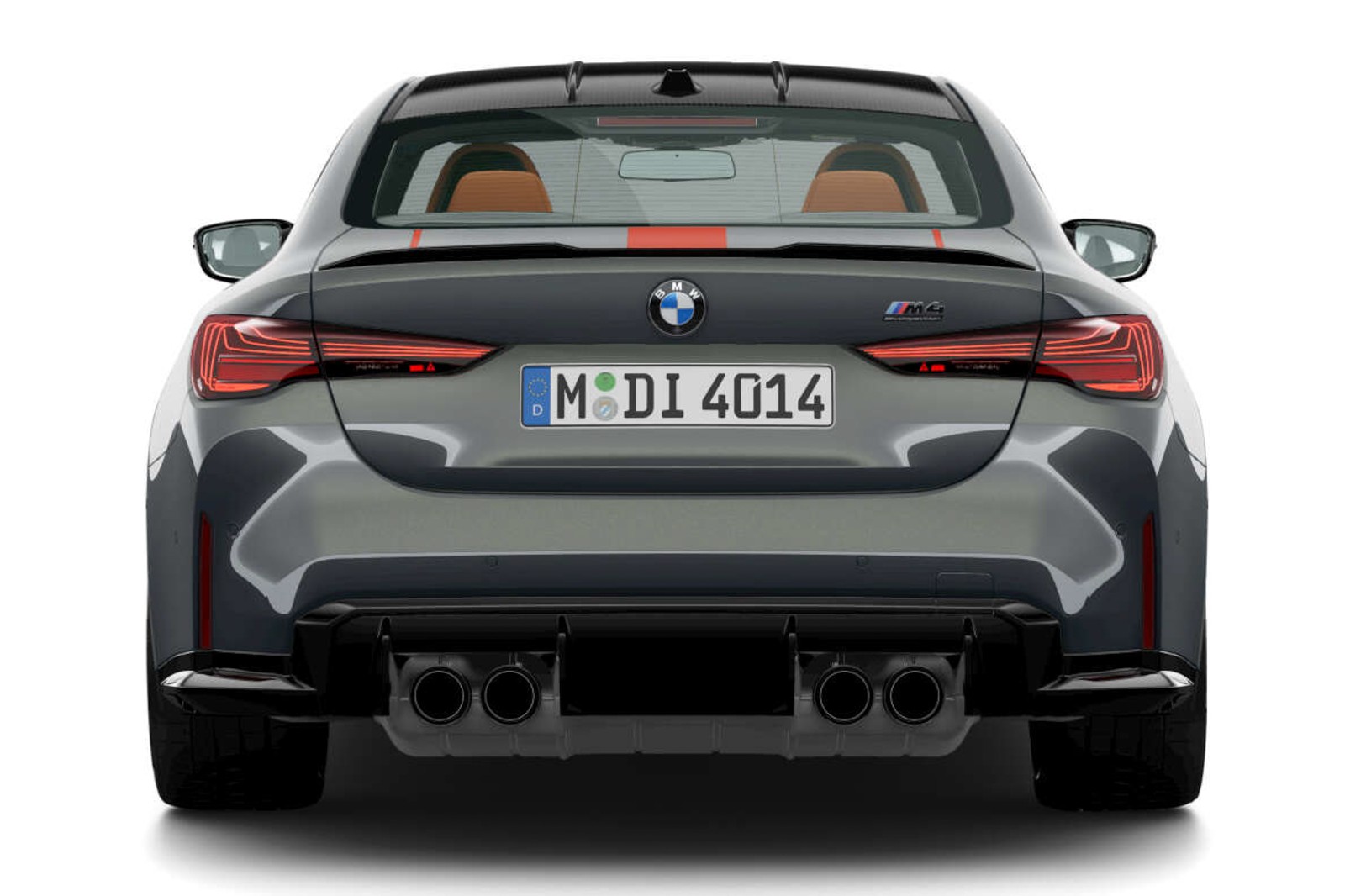
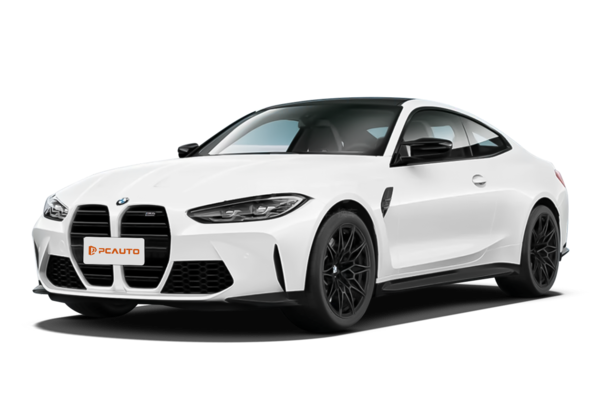
2024 BMW M4 Competition Coupe
Price
RM 870,800
Summary
Drivers love the 2024 BMW M4 Competition Coupe, a Sports Car Coupe launched in 2024-8-20. At RM 870,800, it’s great value. Carry 4 people easily – the roomy interior measures 4801mm long, 1887mm wide, and 1398mm tall. Ideal if you haul kids or gear but want easy city handling.
It cruises smoothly at up to 250km/h. With its 2993cc engine, you get lively acceleration without high fuel costs. For a versatile ride that’s stylish and dependable, the 2024 BMW M4 Competition Coupe ticks every box.
It cruises smoothly at up to 250km/h. With its 2993cc engine, you get lively acceleration without high fuel costs. For a versatile ride that’s stylish and dependable, the 2024 BMW M4 Competition Coupe ticks every box.
Core Specs

Segment
Sports Car

Engine Capacity(cc)
2993

Transmission
AT

Fuel Comsumption (L/100km)
10.2

Fuel Tank(litres)
59

Top Speed(km/h)
250

Seats
4

Length(mm)
4801

Width(mm)
1887

Height(mm)
1398

Wheelbase(mm)
2857

Boot Volume(L)
440
Other Variants
Price
RM 870,800
Body
4801×1887×1398
Engine Power(PS)
530
Engine Torque(Nm)
650
TRANSMISSION
AT
Fuel Consumption
10.2
Related Q&A
View More >Q
What are two uses of fuel oil?
The two main uses of fuel oil include applications in the power industry and the steel industry. In the power industry, it is mainly used in oil-fired power generation and heating units to provide stable energy for electricity production and heat supply. It also serves as ignition, combustion-supporting, and flame-stabilizing oil for coal-fired units, ensuring the stability of the units during startup and operation. In the steel industry, fuel oil can be used in heating furnaces to meet the high-temperature heating requirements during steel processing, as well as in power generation and heating processes of captive power plants and the production of refractory materials. Additionally, fuel oil is commonly used as marine boiler fuel and in the production of flat glass and architectural sanitary ceramics in the building materials industry, making it one of the important energy sources in the industrial sector.
 TedDec 30, 2025
Q
proton x50 berapa cc
The Proton X50 is powered by a 1.5-liter turbocharged three-cylinder engine, with a specific displacement of 1498cc. This engine comes in two tuning versions: the standard variant churns out 150PS of maximum horsepower and 226Nm of peak torque, while the higher-spec version ups the ante to 177PS and 255Nm. Paired with a 7-speed dual-clutch transmission, it strikes a nice balance between performance and fuel efficiency.
As a B-segment SUV, the X50's engine tech hails from the modular platform developed jointly by Geely and Volvo. It boasts advanced features like direct fuel injection and a low-inertia turbo, making it well-suited for both city commuting and the occasional long highway stretch.
One thing Malaysian buyers should keep in mind is the configuration differences across the trim levels – Standard, Executive, Premium, and Flagship. The Flagship, for instance, comes standard with the ADAS driver assistance system, though all trims share the same engine displacement.
For owners who care about maintenance, it's advisable to stick to the factory-recommended 10,000 km or 6-month service intervals, and use fully synthetic engine oil certified by PROTON EDGE. This helps ensure the turbo engine runs reliably over the long haul. Also, given Malaysia's hot climate, you might want to consider slightly shorter intervals for replacing coolant and brake fluid.
 FashionistaStylistSep 25, 2025
Q
Is the Chevrolet Malibu a good car?
The Chevrolet Malibu is a mid - to large - sized sedan. In the Malaysian market, it has caught the attention of some consumers for its comfort and practicality. It is equipped with a 1.5T turbocharged engine that can deliver 165 horsepower. Paired with a 6 - speed automatic transmission, it strikes a balance between fuel economy and power requirements for daily driving, making it suitable for family use or long - distance trips. The interior space is spacious, especially the rear legroom, which performs quite well. The standard 7 - inch touchscreen supports Apple CarPlay and Android Auto, meeting the local users' needs for smart connectivity.
However, it should be noted that since Chevrolet's dealer network in Malaysia is relatively limited, it is recommended to check the location of the nearby after - sales service centers before purchasing a car. Also, the second - hand resale value of the Malibu may not be as good as that of Japanese cars in the same class, which is a factor to consider when planning to keep the car for a long time. In Malaysia's hot climate, its automatic air - conditioning system has a good cooling effect, but it is advisable to choose to install heat - insulating films to enhance comfort. There are also similar models in the same class, such as the Honda Accord and the Toyota Camry. Consumers can compare the configurations and prices among different models before making a decision.
 ClimberzAug 8, 2025
Q
Are all cars going to be EV?
Not all cars will switch to pure electric in the short term, but new energy vehicles are gradually becoming the mainstream of the market. Currently, pure electric and hybrid models together account for 7% of new car sales, with the government targeting 20% by 2030, indicating that traditional fuel vehicles will persist for the long term. The market now exhibits a dual-track dynamic: pure electric vehicle sales have surged 102.6% year-on-year, with brands like BYD reducing price barriers through localized production; meanwhile, hybrid models maintain steady 20.5% growth due to their range anxiety-free advantage, making them better suited for regions with underdeveloped charging infrastructure. Notably, as import tax incentives expire by end-2025, prices of fully imported pure electric models may increase 30%-100%, potentially slowing some consumers' transition. Regarding infrastructure, while charging points have reached 5,149 units, the year-end target of 10,000 remains unmet, with approval processes and installation costs continuing to hinder widespread adoption. From an industrial chain perspective, localized assembly plans are accelerating implementation - including the operational launch of BYD's Tanjung Malim plant - which will enhance price competitiveness. Overall, the next decade will see a multi-fuel automotive market where conventional, hybrid and pure electric vehicles coexist, with full electrification awaiting improved infrastructure, mature localized production, and more accessible pricing structures.
 BlazingJan 27, 2026
Q
Why are EV stocks dropping?
The recent decline in Malaysia's electric vehicle (EV) stocks is primarily driven by multiple factors, including policy adjustments, shifts in market supply and demand, and infrastructure bottlenecks. Firstly, after the exemption on import duties for complete vehicles expires at the end of 2025, prices of import-dependent EVs may increase by 30% to 100%, directly suppressing consumer demand, particularly impacting sales in the high-end market. Secondly, although the government has introduced incentives such as an 85% reduction in EV road tax by 2026, the progress in charging station construction lags behind (with only 5,149 units completed as of September 2025, significantly below the annual target of 10,000). High installation costs and bureaucratic inefficiencies have further eroded consumer confidence. Additionally, intensified industry competition has pressured profit margins. While the shift toward localized production (e.g., SAIC and BYD accelerating their CKD operations) is beneficial in the long term, short-term investment costs must be absorbed. Notably, hybrid models have gained preference due to their price advantage (with sales growing 20.5% in the first nine months of 2025), diverting some demand from the pure EV market. Overall, the volatility in the EV sector reflects the transitional challenges as the market evolves from policy-driven growth to industrial chain maturity. However, long-term prospects remain positive, supported by the potential of localized production capacity and policy synergies.
 DreamyEscapeJan 26, 2026
Q
What is the rating of the Mercedes GLC 2023?
In 2023, the Mercedes-Benz GLC received wide acclaim in the Malaysian market. Its comprehensive score usually reaches 4.5 stars (out of 5) in professional car reviews. This mid - size luxury SUV has won recognition with its exquisite interior texture, advanced MBUX intelligent interaction system, and efficient 2.0 - liter turbocharged engine (available in two tuning versions, GLC 200 and GLC 300). Meanwhile, the standard 4MATIC all - wheel drive system and adaptive suspension have also enhanced its adaptability to various local road conditions.
For Malaysian consumers, the 2023 GLC has optimized its configuration for the tropical climate, such as an enhanced air - conditioning system and ultraviolet - insulating glass. In terms of safety, it is equipped with DRIVEPILOT intelligent driving assistance, which includes 7 active safety functions like lane - keeping and automatic emergency braking.
It's worth noting that competitors in the same class, such as the BMW X3 or Audi Q5, also perform excellently. However, the GLC focuses more on creating a luxurious atmosphere and comfort - oriented tuning. Although its maintenance cost is higher than that of Japanese models, it aligns with the positioning of German luxury cars. It is recommended that potential car owners refer to the latest promotion plans and the 5 - year original factory warranty policy on the official Mercedes - Benz Malaysia website. At the same time, they can make an appointment for a test drive to experience its user - friendly features like the electric rear - seat adjustment.
 InfernoFlameFeb 16, 2026
Q
How to open Smart #1 key?
To open the car key of the Smart #1, you first need to find the physical button or touch area on the key. Usually, there will be a small groove or button on the side or back of the key. You can use your fingernail or a thin tool to gently press it, and the mechanical key will pop out. Some models may require you to slide the key cover. As an electric vehicle, the key design of the Smart #1 focuses on simplicity and a sense of technology. It may support Bluetooth keyless entry or remote control via the mobile app. It is recommended that car owners download the official app at the same time to unlock more convenient operations.
In Malaysia's hot and rainy climate, it is recommended to regularly check the battery level of the key (usually a CR2032 model) and avoid long - term exposure to the sun. If the key malfunctions, you can try to use the spare key or contact the Smart authorized service center for handling.
For the keys of electric vehicles from other brands, the operation logic is similar, but the specific design may vary by brand. For example, Tesla completely relies on the mobile phone Bluetooth or card key, while the keys of electric vehicles from traditional automakers are more similar to those of fuel - powered vehicles.
No matter what kind of key it is, proper storage and regular maintenance are the keys to extending its service life. If you encounter technical problems, you should first consult the official channels of the brand for accurate guidance.
 FayAug 5, 2025
Q
How to start a Toyota Yaris 2024?
Starting up the 2024 Toyota Yaris is a breeze. First, make sure the gear is in P (Park), then press down on the brake pedal. Hit the start button if it's keyless entry, or pop the key in and turn it clockwise to the start position. Once the engine fires up, you can let go of the brake. For the hybrid version, the system does a quick self-check first, then the electric motor kicks in silently—keep an eye on the dash for the "Ready" light, that’s your cue it’s good to go. With Malaysia’s sweltering heat, it’s smart to let the engine idle for a bit to let the oil circulate before cranking up the AC; it helps the engine run more efficiently.
One handy feature on the 2024 Yaris is the smart start-stop system. It’ll automatically shut off the engine at red lights to save fuel, then fire right back up when you lift off the brake—super useful in traffic-heavy spots like KL. If you’re not gonna drive for a while, remember to start the engine periodically to keep the battery charged, especially the 12V auxiliary battery in hybrid models. New drivers should take a minute to learn the dashboard lights too—like the green "ECO" light that means you’re driving in fuel-saving mode.
Oh, and with Malaysia’s humidity, keep that smart key away from water. If the sensor acts up, there’s a mechanical key hidden inside the fob you can use to unlock the doors.
 VenomStrikeOct 14, 2025
Q
What engine is in the 2022 V60 T6?
The 2022 Volvo V60 T6 packs a 2.0-liter four-cylinder engine with both turbocharging and supercharging – a twin-charged gasoline setup paired with a plug-in hybrid system (PHEV). This powertrain cranks out a solid 340 horsepower and 400 Nm of peak torque, mated to an 8-speed automatic transmission, striking a nice balance between strong performance and efficient fuel economy. It’s built on Volvo’s clever Drive-E technology, where the twin-charged design eliminates that annoying power lag you sometimes get with smaller engines at higher revs. Plus, the plug-in hybrid system lets you zip around on pure electric power for short trips, which is perfect for Malaysians who mix city commuting with longer drives. What’s really cool is that this powertrain sits at the higher end of the spec sheet in Malaysia – it satisfies those craving performance while also qualifying for the government’s tax incentives on eco-friendly vehicles. For Malaysian buyers, the V60 T6’s powertrain makes it a strong contender in the luxury wagon segment. It keeps Volvo’s usual focus on safety and comfort but adds better fuel efficiency, which is a big plus with Malaysia’s unpredictable fuel prices – the hybrid system’s cost-saving benefits really shine here.
 NovaOct 22, 2025
Q
What is the Fuel Consumption of Toyota Harrier?
The fuel consumption performance of the Toyota Harrier varies depending on the specific model and powertrain configuration. Currently, in the Malaysian market, the 2.0-liter turbocharged gasoline engine version (model 8AR-FTS) commonly seen has a combined fuel consumption of approximately 7.5 to 8.5 liters per 100 kilometers. The hybrid version (equipped with a 2.5-liter A25A-FXS engine and the THS II system) is more fuel-efficient, with a combined fuel consumption as low as 5.0 to 5.8 liters per 100 kilometers. The actual fuel consumption will be affected by driving habits, road conditions, and the vehicle's maintenance status.
It's worth noting that hybrid models can fully leverage the advantage of electric power assistance in congested urban roads, and their fuel consumption performance is better than that of traditional fuel-powered vehicles. For Malaysian consumers, choosing the hybrid version not only helps save on fuel costs but also allows them to enjoy the government's tax incentives for energy-efficient vehicles (EEV).
It is recommended that before purchasing a car, you can refer to the latest data on the official website of Toyota Malaysia or take a test drive in person. Since 2023, some models may be equipped with the optimized Dynamic Force engine, which will further improve fuel economy. Additionally, regular maintenance such as replacing the air filter, using engine oil with the appropriate viscosity, and maintaining the correct tire pressure are all effective ways to optimize fuel consumption.
 CherryblJul 31, 2025
Popular Cars
Model Year
Car Compare
Car Photo