
Q
Is the maintenance cost of Veloster high?
 CherryblJun 04, 2025, 11:24 AM
The Hyundai Veloster's maintenance expenses fall into the mid-range category in Malaysia, slightly higher than comparable Japanese performance models but not excessively expensive. A basic service (including engine oil, oil filter, and routine inspection) typically costs around RM300–RM450, recommended every 10,000 km or 6 months.
Compared to conventional family cars, the Veloster's turbocharged engine requires higher-quality lubricants and components, resulting in moderately elevated maintenance costs. For example, an air filter replacement ranges between RM120–RM200, while spark plug changes cost approximately RM400–RM600 (depending on OEM or aftermarket parts).
Given the Veloster's unique 1.6T GDi engine configuration, certain proprietary parts may carry a premium over naturally aspirated equivalents. However, owners can moderately reduce expenses by opting for reputable third-party workshops outside authorized service networks.
It's worth noting that the Veloster's relatively limited market presence in Malaysia means some specialized components may require ordering in advance. Thus, using genuine parts is advised to ensure long-term performance reliability.
Overall, while the Veloster's upkeep costs aren't prohibitive, they remain noticeably higher than typical commuter vehicles—a trade-off that aligns with its positioning as a distinctive performance-oriented choice for buyers with flexible budgets seeking a personalized driving experience.
Special Disclaimer: This content is published by users and does not represent the views or position of PCauto.
Related Q&A
Q
Is Hyundai Veloster a race car?
The Hyundai Veloster is not a purpose-built race car, but it does have several performance-oriented elements. Powered by a turbocharged 1.6-liter engine producing 187 horsepower, it can reach a top speed of 214 km/h and accelerate from 0 to 100 km/h in just 8 seconds. The dual-clutch transmission (DCT) and front-wheel-drive layout deliver an engaging driving experience.
Its MacPherson strut front suspension and ventilated disc brakes on both axles enhance handling and braking performance. However, compared to a true race car, it lacks features like a stripped-down interior for weight reduction, a highly tuned racing engine, or a full roll cage.
The Veloster is better described as a sporty road car designed for daily driving, with performance enhancements that appeal to drivers seeking excitement on open roads without the extreme compromises of a dedicated race vehicle.
 BronzeBeastJun 4, 2025
Q
Is Hyundai Veloster an SUV?
No, Hyundai Veloster is not an SUV, but a Class C compact car. SUV is the abbreviation of Sport Utility Vehicles, which usually has a higher ground clearance, and many SUVs are equipped with a four - wheel drive system to enhance off - road performance. Also, its interior space is generally larger and more spacious, especially in terms of cargo space and passenger space.
Compared with SUVs, the Veloster has a lower body stance. It is 4250 millimeters long, 1805 millimeters wide, and 1405 millimeters high. In addition, it comes standard with front - wheel drive, and its structure meets the characteristics of traditional compact cars. It runs on gasoline, and it is equipped with a 1.6 - liter turbocharged engine. It has 60:40 split - folding rear seats and a 440 - liter trunk, focusing more on providing the typical sporty driving experience of a compact car rather than the versatility and off - road capabilities of an SUV.
 StormBreakerJun 4, 2025
Q
Is Hyundai Veloster a sports car?
The Hyundai Veloster can be regarded as a sports car to some extent. It's an entry - level sports car launched by Hyundai, which is equipped with a 1.6 - liter turbocharged engine that can output 187 horsepower. As a compact car, the power is relatively strong. The maximum speed can reach 214 km/h, and the acceleration time from 0 to 100 km/h is 8 seconds.
It has some sporty design features. Its exterior design is unique and eye - catching, which is quite attractive to those who pursue sports aesthetics. In addition, it is equipped with a dual - clutch transmission (DCT), which can achieve quick gear changes and bring a more enjoyable driving experience. The MacPherson independent suspension used both at the front and rear and the ventilated disc brakes improve the handling and braking performance, which are crucial for a sports car.
Inside the car, configurations such as the electrically adjustable driver's seat, the rear seats that can be folded down in a 60:40 ratio, and the single - zone automatic air - conditioning system strike a balance between comfort and sportiness. Considering all these factors, the Hyundai Veloster has the characteristics of a sports car.
 TornadoTwistJun 4, 2025
Q
Why does Hyundai Veloster only have 3 doors?
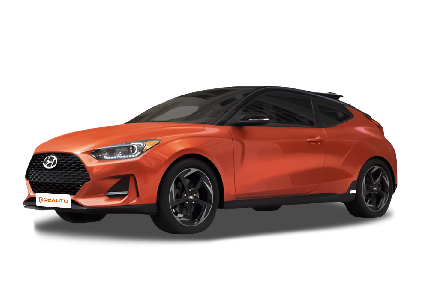
The Hyundai Veloster features a unique 2+1 asymmetric three - door layout. There is one door on the driver's side and two doors on the front - passenger side. This design offers two main advantages. On one hand, it facilitates the entry and exit of rear - seat passengers. Usually, rear - seat passengers get in and out from the right side, and the two doors can make it easier for them to access the rear seats. On the other hand, this layout is extremely rare, which enhances the visual impact, making the vehicle's appearance more distinctive and individual, allowing it to stand out among numerous car models.
In addition, the hidden rear - door handle design further enhances the overall smooth lines and the coupe style of the vehicle. It also makes the car look like a two - door sports car from certain angles, combining the stylishness and practicality of a two - door sports car.
 OceanblueJun 4, 2025
Q
What are the advantages of Hyundai Veloster?
The Hyundai Veloster has quite a few advantages. In terms of exterior design, it has graceful lines and unique design elements like the central dual - exhaust, appealing to various consumers.
Regarding the power performance, it is equipped with a 1.6T engine, delivering strong power. The official 0 - 100km/h acceleration time is 8 seconds. When you step hard on the accelerator, the engine speed rises rapidly, and you'll feel a strong sense of push in the back.
The in - car configuration is also quite rich. Standard features include ABS anti - lock braking, electronic stability control, 6 airbags, ISOFIX child seat anchors, rear parking sensors, a parking image system, hill - start assist, a multi - function steering wheel, steering wheel paddle shifters, a 220V/230V power supply, and keyless entry.
In terms of space, it's basically sufficient for people of average figure. The middle part of the rear row is flat without a bulge, and the trunk has a capacity of 440L.
Moreover, the vehicle provides a 5 - year or 300,000 - kilometer warranty, which can relieve the owners of potential worries.
 GracefulMovementJun 4, 2025
Q
Does Hyundai Veloster have high fuel efficiency?
The official fuel consumption of Hyundai Veloster is 8.1 liters per 100 kilometers. Whether it's fuel-efficient depends on various factors. Compared with some compact cars that have smaller engines and might achieve lower fuel consumption, the Veloster's 8.1 liters per 100 kilometers doesn't seem extremely fuel - saving. However, considering that it belongs to the C - class size and is equipped with a 1.6 - liter turbocharged engine that can output 187 horsepower, this fuel consumption is reasonable.
In addition, the actual fuel consumption can vary significantly depending on driving habits (for example, frequent rapid acceleration or hard braking will increase fuel consumption) and road conditions (such as stop - and - go city traffic or highway driving). For those who want to get a certain amount of power in a C - class car without overly sacrificing fuel economy, the Veloster strikes a balance between performance and fuel consumption.
 LavendersJun 4, 2025
Q
Is Veloster a small car?
The Veloster belongs to the compact car category and is generally not regarded as a traditional small car. In terms of car segment classification, it falls into the C-Segment, which means it's a compact car with a body length of 4,250mm, a width of 1,805mm, a height of 1,405mm, and a wheelbase of up to 2,650mm. Compared with typical small cars, such as those with a length of less than 4 meters and a wheelbase of around 2,500mm or even shorter, the Veloster is larger in size. Moreover, the Veloster is usually equipped with a 1.6-liter turbocharged engine with a maximum horsepower of 187PS, and its power output is also stronger than that of many small cars. Its unique 2 + 1 door design and sporty tuning also make it more inclined towards the positioning of a compact sports car. Its overall performance and space performance are between those of small cars and mid - sized cars.
 PeachesrJun 4, 2025
Q
What's the lifespan of Hyundai Veloster?
There's no fixed standard for the service life of the Veloster, as it's affected by various factors. Under normal use and maintenance, the vehicle could reach a mileage of 600,000 kilometers or be used for 15 years. From the perspective of the vehicle warranty, the Veloster offers a 5 - year or 300,000 - kilometer warranty, which means the vehicle can maintain a good condition at least within this period.
If you carry out regular maintenance on time, have good driving habits, and drive in suitable conditions, the vehicle's lifespan will be longer. On the contrary, improper use and untimely maintenance may lead to various malfunctions and shorten the service life. For instance, long - term aggressive driving and not changing the engine oil on schedule can damage components such as the engine.
However, even if the vehicle has been used for more than 15 years or has exceeded a mileage of 600,000 kilometers, it can still continue to be used as long as it passes strict inspections.
 ButterflyJun 4, 2025
Q
Is Hyundai Veloster a good choice?
Hyundai Veloster has many commendable features and is a great car. It falls under the C-segment category, with a unique exterior that appeals to consumers seeking individuality. In terms of interior space, it measures 4,250 mm in length, 1,805 mm in width, and 1,405 mm in height, with a wheelbase of 2,650 mm. The 4-seat design is well-suited for small families or outings with friends. A 50L fuel tank ensures decent range, while the 440L trunk capacity meets daily storage needs. In performance, it is equipped with a 1.6L turbocharged engine delivering a maximum horsepower of 187 PS, with an official 0-100 km/h acceleration time of 8 seconds and a top speed of 214 km/h, showing robust power. Additionally, it comes with an array of features, including standard safety configurations such as ABS, electronic stability control, and six airbags, as well as comfort and convenience features like a multifunction steering wheel, paddle shifters, and automatic headlights. The vehicle is backed by a 5-year or 300,000 km warranty, ensuring reliable after-sales service. Priced from RM 154,488, it holds competitive appeal within its segment.
 RainbowsJun 4, 2025
Popular Cars
Model Year
Car Compare
Car Photo
Related Models
 Cars
CarsLatest Q&A
Q
Is AMT similar to automatic?
There are significant differences between AMT transmissions and automatic transmissions (AT) in terms of core structure and driving experience. AMT is essentially an electronically automated version of a manual transmission, simulating manual clutch operation and gear shifting through a computerized control system while retaining the gear set structure of manual transmissions. As a result, it offers higher transmission efficiency, with fuel consumption approximately 8%-12% lower than AT, making it particularly suitable for highway or long-distance driving. However, it may exhibit jerking similar to manual transmissions during low-speed gear shifts, especially noticeable in congested traffic conditions.
AT transmissions rely on torque converters for power transfer, delivering smooth and seamless gear shifts that appeal to comfort-oriented users. However, their complex structure (incorporating planetary gear sets, hydraulic systems, etc.) results in higher maintenance costs. A single service may cost between 800 to 1,500 ringgit, whereas AMT only requires gear oil replacement at approximately 400 ringgit.
From a market perspective, AMT is predominantly used in budget vehicles or commercial models priced below 80,000 ringgit, while AT is typically featured in mid-to-high-end vehicles. Consumers should select based on actual needs: AMT suits those prioritizing fuel efficiency and low maintenance costs, while AT better serves those valuing comfort. Notably, recent advancements in AMT electronic control technology have significantly mitigated jerking issues, though test drives should still emphasize low-speed performance evaluation.
 AriaMar 26, 2026
Q
Which is better, DCT or AT?
DCT (Dual-Clutch Transmission) and AT (Automatic Transmission) each have their own advantages and disadvantages, and the choice should be based on personal driving needs. AT transmissions transfer power through a torque converter, offering excellent shift smoothness, making them suitable for urban commuting or novice drivers. However, they tend to have higher fuel consumption, and vehicles equipped with them are usually more expensive. DCT transmissions utilize a dual-clutch structure, featuring fast shift speeds and high power transmission efficiency, which provides a more direct driving experience—particularly suitable for users seeking a sporty feel. However, they may exhibit jerking at low speeds and have relatively high maintenance costs. If durability and comfort are priorities, AT is the more reliable choice; if power responsiveness and driving pleasure are preferred, wet DCT (such as Volkswagen DSG) performs better, though dry DCT models should be avoided in prolonged stop-and-go traffic conditions. Additionally, CVT transmissions excel in smoothness and fuel efficiency, making them ideal for daily commuting, but they lack driving excitement. It is recommended to test-drive before purchasing, as tuning varies significantly across brands, and real-world experience is more important than theoretical specifications.
FlutteringMar 26, 2026Q
Is Amt good or bad?
AMT gearboxes have a significant cost advantage in the local market, typically being around 5,000 Ringgit cheaper than models equipped with conventional automatic transmissions. Their fuel efficiency is comparable to manual transmissions, resulting in long-term fuel savings. Featuring a straightforward design, they achieve transmission efficiency exceeding 90% with relatively low maintenance costs, making them ideal for practicality-oriented consumers. However, their shifting logic contains inherent limitations: gear changes between 1st and 2nd cause 0.3-0.5 second power interruptions, while unintended upshifts on inclines may reduce engine speed by 15%-20%, compromising driving smoothness. For urban commuters or budget-conscious buyers, AMT offers excellent value, though those prioritizing premium driving dynamics should consider alternative transmission types. Some domestic models like the Perodua Axia employ enhanced AMT systems, where optimized shift programming has reduced gearshift shock by approximately 30%.
RainbowsMar 26, 2026Q
Which gives better mileage, CVT or AMT?
From the perspective of fuel economy, CVT transmissions generally perform better under urban driving conditions. Their continuously variable design allows the engine to consistently operate within the optimal speed range, significantly reducing fuel consumption during frequent starts and stops. Test data shows that their fuel consumption in urban driving conditions is 10% to 15% lower than that of comparable models. AMT transmissions, on the other hand, inherit the high transmission efficiency of manual transmissions, delivering fuel efficiency close to manual transmissions during high-speed cruising. This makes them particularly suitable for long-distance driving in large-displacement vehicles. However, due to power interruption during gear shifts, their overall fuel consumption may be 5% to 8% higher than CVTs.
The difference in fuel-saving characteristics between the two transmissions stems from their technical principles: CVTs achieve continuous variability through steel belts and pulleys, eliminating the fixed gear ratio limitations of traditional transmissions; AMTs simulate manual gear changes via electronic control systems while maintaining the mechanical efficiency of gear transmission. Notably, actual fuel consumption is also influenced by driving habits. Smooth acceleration and anticipatory deceleration can maximize the transmissions' fuel-saving potential. If the vehicle budget permits and urban commuting is the primary use, CVTs offer a more economical choice. For frequent highway driving with an emphasis on cost-effectiveness, AMTs are equally worth considering.
 RubyBlazeMar 26, 2026
Q
Which is cheaper, AMT or CVT?
In terms of gearbox cost, AMT is usually more economical than CVT. Essentially, AMT is a manual transmission equipped with an electronic control unit, featuring a simple structure and low maintenance costs. The unit price ranges from approximately 5,000 to 8,000 ringgit, making it suitable for budget-conscious consumers or those who prioritize long-term operating costs. CVT incurs higher manufacturing costs due to its precision steel belt transmission system and continuous variable transmission technology, with a unit price of about 7,000 to 10,000 ringgit. However, it delivers a smoother driving experience and superior fuel efficiency. The primary differences between the two lie in technical complexity: AMT retains the gear-shifting mechanism, resulting in noticeable shift shock; CVT achieves linear power output through stepless speed variation but requires periodic belt inspection and incurs higher maintenance expenses. For those prioritizing initial cost and basic transportation needs, AMT offers better value; if comfort and long-term fuel economy are priorities, CVT represents a more worthwhile investment. Note that actual prices may vary based on vehicle model, brand, and local supply chain factors.
 ShadowProwlMar 26, 2026
Related News

Malaysia Hyundai Staria 2026 model optimized 10-seater layout, central console upgraded
Kevin WongJan 28, 2026

Hyundai STARIA Electric Version Unveiled: Spacious MPV, Southeast Asian Families Should Look Forward to it!
WilliamJan 12, 2026

2026 Toyota HiLux receives five-star ANCAP safety rating in ANCAP
MichaelDec 12, 2025

In Malaysia, which sliding door MPVs are available?
MichaelOct 30, 2025

Modern Ioniq 5 N Lands in Malaysia: Track-Level Performance Electric Vehicle is Here, Priced Possibly Below RM 400,000?
JohnSep 10, 2025
View More
Pros
Cons