
The Fast and Furious World of Formula One: A Thrilling Ride for Malaysian Fans
 JamesFeb 23, 2024, 09:25 PM
Formula One (short for F1) is the highest level annual series of track racing competitions sponsored by the International Automobile Federation (FIA), officially known as the "Formula One Championship".
Explanation of the term Formula One Racing
Formula One (short for F1) is the highest level annual series of track racing competitions sponsored by the International Automobile Federation (FIA), officially known as the "Formula One Championship".
F1 is considered by many as the most important event in the racing world and also the most expensive sport, with its cars often using the most advanced technology in the automobile industry. F1 holds a series of races each year, the tracks are fully enclosed special race tracks, or temporarily closed general road race tracks. Every year, about 10 teams compete in 16 to 20 races to compete for the annual championship title. F1 racing originated in Europe and has now become popular all over the world.
A F1 Championship represents a season's races, and each season includes many races, known as "Grands Prix" (French: Grand Prix). The term "Grands Prix" originally meant "high bonuses" in French, but because it is often used in various competitions (not necessarily vehicle sports, or even outside the field of sports), it is widely known. So today, even if it is directly called GP, people usually understand it asrepresenting a competitive match.
The Grand Prix is a race, so it must have a racetrack where the race is actually held. Usually, most of the Grands Prix have their traditional racetracks used for many years, but this is not always the case, some special Grands Prix may change the field once a year or every few years, or cycle between different fields. (List of Current Grand Prix)
F1 Australia Grand Prix
F1 Malaysia Grand Prix
F1 China Grand Prix (Shanghai F1 Grand Prix)
F1 Bahrain Grand Prix
F1 Spain Grand Prix
F1 Monaco Grand Prix
F1 Canada Grand Prix
F1 Europe Grand Prix
F1 Britain Grand Prix
F1 Germany Grand Prix
F1 Hungary Grand Prix
F1 Belgium Grand Prix
F1 Italy Grand Prix
F1 Singapore Grand Prix
F1 Japan Grand Prix
F1 Korea Grand Prix
F1 India Grand Prix
F1 Abu Dhabi Grand Prix
F1 United States Grand Prix
F1 Brazil Grand Prix
F1 Grand Prix
F1 Scoring Rules
The scoring rules were greatly revised in 2010, and the top ten have points, as follows:
First place: 25 points
Second place: 18 points
Third place: 15 points
Fourth place: 12 points
Fifth place: 10 points
Sixth place: 8 points
Seventh place: 6 points
Eighth place: 4 points
Ninth place: 2 points
Tenth place: 1 point
Introduction to F1 Flag Language
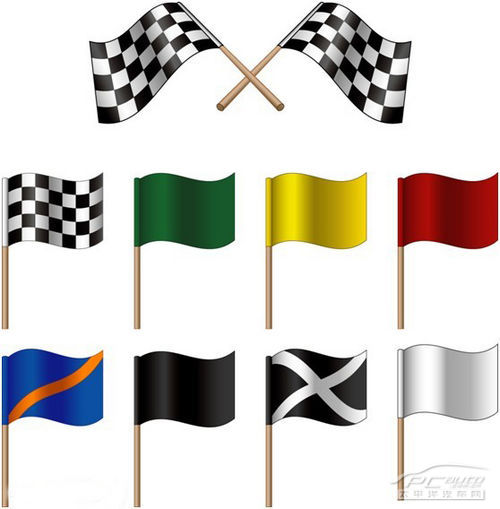
Yellow Flag: It indicates that there are obstacles on the track ahead, such as a crashed or faulty race car. It prompts drivers to drive carefully. If the obstacle car is parked on the side of the track, or the obstacle is not on the track, then the yellow flag will remain still. If the obstacle is on the track, then the yellow flag will be waved back and forth to alert drivers to prepare to change directions. If the track is completely blocked, then two yellow flags will be waved. Overtaking is not allowed when the yellow flag is displayed. If a driver does not seriously read the information of the yellow flag and still drives at race speed to the section of the track where the accident occurred, then the driver will be severely penalized, and even disqualified.
Red and Yellow Vertical Stripes Flag: It indicates that there is oil on the road surface ahead or the road surface is slippery. Drivers should drive carefully until the signal flag is withdrawn. If race officials wave this flag, it means there is a so-called slippery area not far ahead.
White Flag: When the white flag is displayed, it indicates that there is a slow-moving vehicle ahead. This could be an ambulance, a tow truck, or a race safety vehicle. When the white flag is displayed, drivers should drive carefully and even slow down appropriately.
Red Flag: The red flag means that the race or trial ended or suspended early for some reason. The red flag will be displayed at all positions on the track at the same time. At this time, drivers should return to the repair station and stay there to know whether to resume the race and when to resume. During the official race, if the red flag is displayed after more than 75% of the race, the race ends, and the final results of the race will be based on the results of two laps before the red flag is waved.
Blue Flag: The blue flag indicates that a lapping vehicle is approaching from behind and is preparing to overtake. The driver who is shown the blue flag should slow down and give way, if necessary, give up the race line. If a driver has not been able to make way for the fast car within 3 bends after being shown the waving blue flag, the driver may be penalized.
Green Flag: The green flag indicates that the race or qualification has started or the obstacles on the track have been cleared, and the race has resumed normally.
Black Flag: If the driver's number is displayed on the starting line and a black flag appears next to it, it means that the driver needs to report to the repair station after completing this lap. When a driver needs to be investigated for improper racing behavior, or when a driver violates the rules during the race, a black flag should be displayed to the driver. When this flag appears, the driver is disqualified from the race.
Black Bottom Red Circle Flag: If the driver's number is displayed on the starting line and a black bottom red circle flag appears next to it, it means that the driver needs to contact the inspection station immediately. When race officials suspect that the driver's car has mechanical problems that need to be inspected, they will display a black bottom red circle flag.
Black and White Checker Flag: When the black and white checker flag appears, it means the race or practice race is over. At this time, all drivers should return to the repair lane or concentrate in the starting area. From here, the drivers need to drive their cars to the pre-race check-in, where the cars need to be checked to ensure they comply with all competition regulations. For each race winner, the black and white checker flag will be waved for him; for the drivers after the champion, the black and white checker flag will be displayed still.
Teams Participating in F1
Teams currently participating in the race:
Ferrari
Lotus
Williams
McLaren
Red Bull Racing
Toro Rosso
Force India
Mercedes
Carterham
Marussia
Sauber
F1's Driving License
Just like ordinary road driving, F1 also requires a driving license. It is a "Super License" issued by the FIA - FIA Super Licence. This driver's license is only issued to outstanding drivers in the F3000, F3 or CART series. It usually takes a driver eight years to gradually advance from small karting to F1, but in fact only a few people have the ability and opportunity to reach the top of the racing pyramid.
The starting point for the Super License in 2009 was 10,400 euros, in addition to gaining points at a starting point of 2,100 euros/point, plus an additional 2,720 euros in insurance fees. The figures for the previous year were 1,725 euros and 456 euros, respectively.
Physical traits of F1 drivers
F1 drivers are some of the most physically fit athletes, because the driving method of F1 cars and the powerful centrifugal force that drivers must withstand are vastly different from driving ordinary vehicles. They not only need to be in a better physical condition than ordinary people, but also need a calm and analytical mind!
If you observe F1 drivers, you can find that they all have thick necks that look almost as wide as their heads.
If any infringement occurs, please contact us for deletion




Popular Cars
Model Year
Car Compare
Car Photo