
Xpeng G7 + Huawei HUD = Unstoppable Visibility
 AshleyJun 05, 2025, 06:09 PM
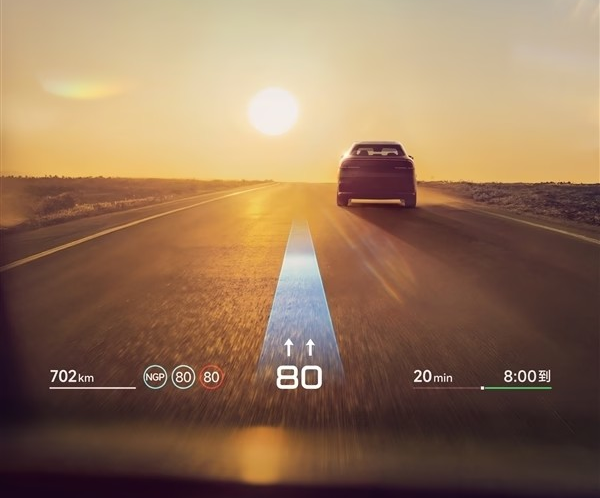
【PCauto】Recently, Xpeng announced the launch of an all-new XHUD solution, and the first model adopting it is the upcoming Xpeng G7. One particularly noteworthy highlight of this collaboration is that this augmented reality head-up display (AR-HUD) from HUAWEI offers three key functions:
AR Navigation: High-precision lane-level navigation, virtual-real space fusion algorithms, real-time rendering, and anti-shake technology.
Safety Enhancement: The industry-first function of marking lane lines and vehicle positions in rainy or foggy conditions, improving driving safety in low visibility.
Information Integration: Displays range, speed, and assisted driving status, eliminating the need for a traditional instrument panel design.
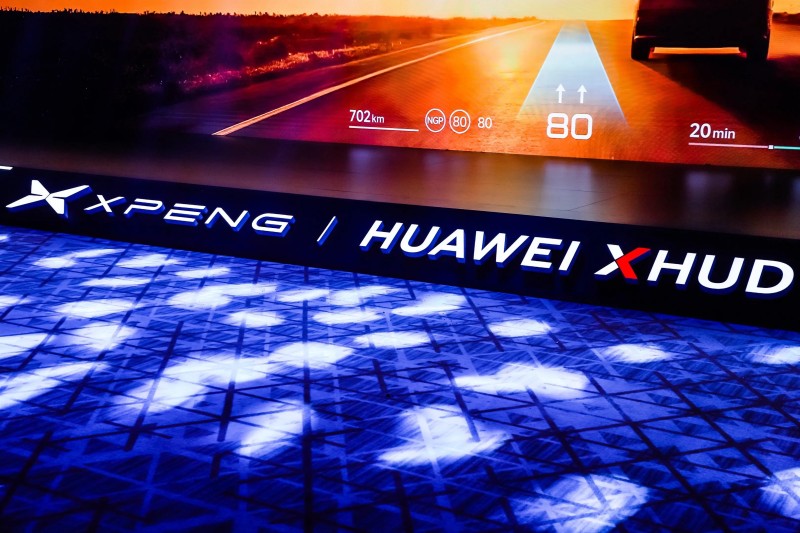
87-Inch Virtual Display Projected on Windshield
Regarding this XHUD feature, Xpeng stated during the launch event that the Xpeng G7's windshield will project an 87-inch virtual display, equivalent to a giant floating screen positioned 7 meters ahead of the vehicle.
The automotive-grade imaging module provided by HUAWEI ensures 100% sRGB color gamut coverage and a brightness of 12,000 nits, making speed and range information clearly visible even under direct midday sunlight.
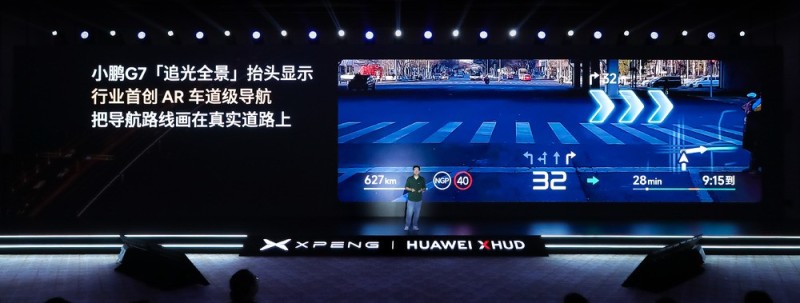
More importantly, its cross-lane display capability stands out: when navigating a four-lane roundabout, turn guidance arrows will precisely hover above the corresponding lanes, allowing drivers to focus on the road without checking the navigation map.
XHUD Marks Lanes and Vehicles in Rain/Fog
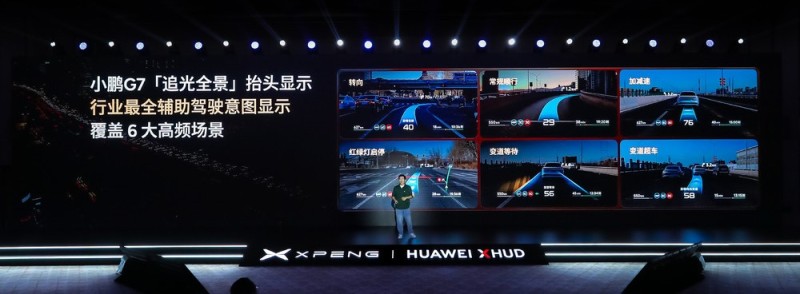
The XHUD's ability to mark lanes and preceding vehicles in rain and fog offers the highest practical value, significantly enhancing driving safety during adverse weather conditions.
By integrating HUAWEI's optical algorithms with vehicle sensor data, the system generates virtual lane markings on the windshield in real-time when heavy rain or dense fog makes visual lane identification impossible.
During a test last year, engineers recorded the system accurately marking lane boundaries up to 40 meters ahead in patchy fog with less than 20 meters of visibility. The lateral warning function also highlights pedestrians obscured by A-pillars with red bounding boxes, providing more intuitive alerts than conventional radar warnings.
Dashboard-Free Driving Enabled by XHUD
Of course, this XHUD system's capabilities extend far beyond weather adaptation. At its core lies augmented reality technology – the precise projection and integration of virtual navigation and driving information onto the real road surface as seen by the driver.
Key data like high-precision lane-level navigation guidance, real-time speed, remaining range, and assisted driving system status are all displayed directly within the windshield's forward view.
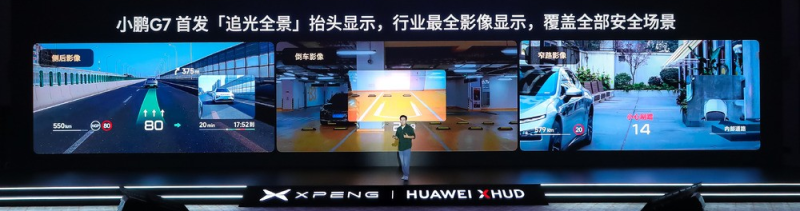
This delivers two benefits: First, drivers no longer need to frequently glance down at the instrument cluster to check critical information, allowing better focus on the road ahead. Second, with all information consolidated in the HUD, the Xpeng G7 eliminates the traditional standalone instrument panel entirely, resulting in a cleaner cabin layout.
Whereas traditional instrument clusters require drivers to shift their gaze downward by approximately 30 degrees, the AR-HUD projects information within a 5-degree zone below natural view. Neuroscience research shows this reduces focus-switching time by 0.3 seconds – equivalent to cutting 8.3 meters of "blind driving" at 100 km/h.
Resolving HUD-Reality Misalignment is Crucial
However, displaying large amounts of complex information on the windshield often leads to misalignment between the projected images and the actual road. This challenge is addressed by the HUAWEI XHUD-AR Composition Engine.
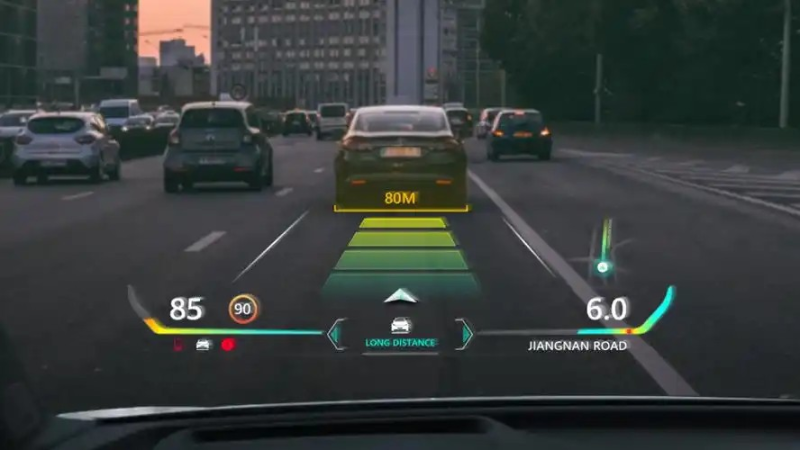
The multi-dimensional coordinate transformation technology enables virtual navigation lines to align with real road surfaces with millimeter-level precision. Even on steep slopes or sharp curves, turn arrows remain firmly fixed at their correct positions. Xpeng engineers demonstrated this with actual test footage of an urban interchange: the system accurately marked continuous lane-change trajectories 300 meters in advance using light strips across five overlapping ramp levels.
Finally
This technology will be implemented in the Xpeng G7, a mid-size all-electric SUV positioned to compete directly with the Tesla Model Y. Compared to vehicles in the same class, its AR-HUD display area exceeds the 70-inch screen of the BMW 7 Series, while its functionality surpasses even the basic navigation prompts offered by the Mercedes-Benz S-Class.
If any infringement occurs, please contact us for deletion




Popular Cars
Model Year
Car Compare
Car Photo